CTV Families Back Judge‑Led Tauranga Inquiry – But Warn of Limits on Truth and Accountability
As Tauranga faces dual inquiries and multiple investigations, CTV families are urging strong family representation, whistleblower protections and a genuinely open process.
The CTV Families Group has welcomed the Government’s decision to appoint a retired Supreme Court judge to lead an independent inquiry into the Tauranga landslides, calling it an important test of whether New Zealand has learned from past failures after major loss‑of‑life events.
“Full independence, transparency, and rigour”
For fifteen years, advocate David Lynch has represented the CTV Families Group, which speaks for the families of the 115 people who died in the CTV building collapse during the February 2011 Christchurch earthquake. Drawing on that experience, Lynch says the Government’s announcement “reflects the seriousness of the tragedy and the clear public expectation that the circumstances leading to the loss of life must be examined with full independence, transparency, and rigour.”
“The lessons from CTV are directly relevant to the current situation,” Lynch says. He argues that the Tauranga landslides now sit squarely in the same category as CTV: a mass‑casualty event with signs of systemic failure and unanswered questions about risk, warnings, and accountability.
Why this inquiry matters
The Government inquiry into the Tauranga landslides will sit alongside investigations by Police, WorkSafe and the Coroner, and has the power to make findings of fault, even though it cannot itself determine civil or criminal liability.
Lynch notes that its conclusions “will play a pivotal role in establishing the factual record, clarifying where responsibility may lie, and informing decisions about whether further action, including potential criminal proceedings, is warranted.”
Because of that, the CTV Families Group is treating Tauranga as a crucial test of whether the system can finally deliver truth and accountability after preventable disaster. “Ensuring the integrity and accessibility of the inquiry process is essential not only for the families but for public confidence in the system as a whole,” Lynch says.
To make the inquiry fit for purpose, the group has put three essential recommendations on the table:
Dedicated, government‑funded legal representation for families, so they can participate meaningfully and protect their interests throughout both the Government inquiry and the police investigation.
Strong whistleblower protections, so “individuals with relevant information must feel safe to come forward” and critical evidence is not withheld “due to fear of repercussions.”
An open and inclusive scope, where “the inquiry chair should be empowered to receive any submissions or evidence that may be relevant to his work,” giving him the flexibility needed to identify systemic issues and ensuring “no line of inquiry is prematurely closed.”
What the Government’s terms of reference actually say
Under its terms of reference, the Government inquiry is asked to:
establish how the landslides happened,
assess whether agencies took appropriate steps to manage risk and to warn or evacuate people, and
identify lessons to reduce the risk of similar tragedies in future.
The terms also makes clear that the Government “does not expect the inquiry to conduct public hearings”, and says hearings should only occur if they are essential to fulfil the terms of reference and can still be completed within the inquiry’s budget and timeframe. The inquiry may only look at legislative, administrative and policy settings to the extent they are found to be a “material cause” of the landslides, and while it must “communicate directly with the families of victims” and Tauranga Moana iwi about the process and progress, there is no commitment to fund legal representation or guarantee families any particular form of participation.
Two inquiries, different roles
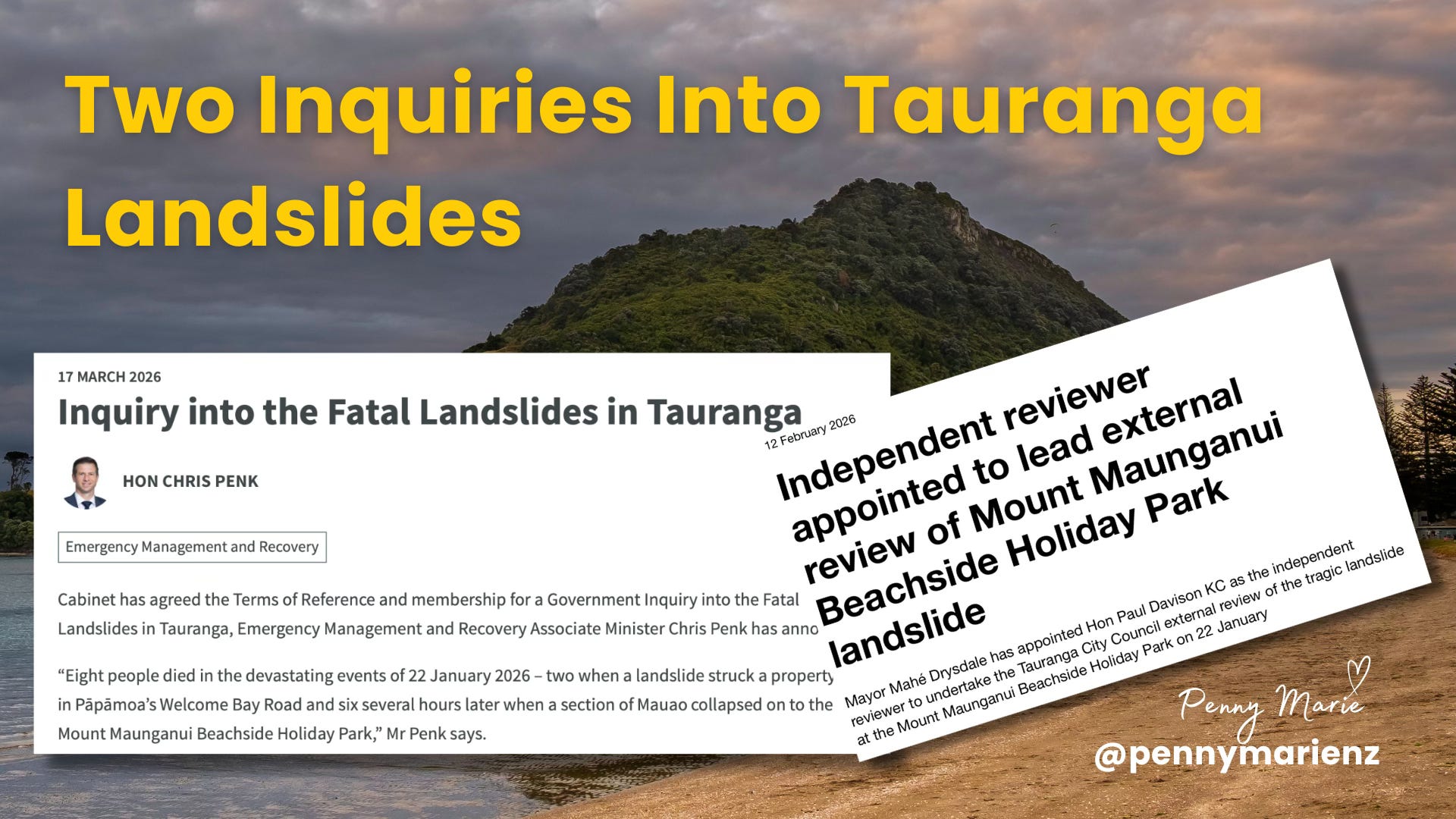
The Tauranga tragedy is now the subject of two main processes: a Government inquiry under the Inquiries Act, and a Tauranga City Council‑commissioned external review.
The Government inquiry is a central government process, ordered by Cabinet and led by retired Supreme Court Judge Sir Mark O’Regan, reporting to ministers and ultimately to Parliament and the public. It covers both fatal landslides in Tauranga (Mount Maunganui/Mauao and Welcome Bay Road, Pāpāmoa) and is tasked with establishing how the landslides occurred, whether agencies took appropriate steps to manage risk, warn and evacuate people, and what lessons must be learned to prevent similar events in future. As a formal inquiry, it can compel evidence, obtain documents and testimony, and make findings of fault that may inform criminal, regulatory or civil action, even though it cannot itself determine liability.
By contrast, the Tauranga City Council review is an “independent external review” commissioned by the council itself, focusing on “the events leading up to the landslide at the base of Mauao” and on what the council and its Emergency Operations Centre knew and did, particularly in the hours before the slip. It is led by retired High Court judge Paul Davison KC and reports back to the council, aiming to be robust and transparent but without the same statutory powers or formal fault‑finding status as the Government inquiry.
Councillors have acknowledged that because the council owns the affected campground, there is an inherent conflict that makes a truly independent Crown‑led process essential.
Both processes are expected to run alongside each other and avoid duplication, with the council review helping the council account to its community and the Government inquiry addressing wider questions of public safety, national systems, and accountability, alongside investigations by Police, WorkSafe and the Coroner.
What about funding?
Public reporting so far has focused on relief funding rather than the specific budgets for the inquiries themselves. The Government has announced packages including around $1.2 million in mayoral relief funding and wider support for affected communities and marae after the storms, but has not yet publicly detailed a dedicated dollar figure for running the Tauranga landslides inquiry. Tauranga City Council, likewise, has described its review as “independent, robust and transparent” but has not published a separate, itemised budget line for the Mauao review.
Penny Marie
Your support is extremely appreciated thank you!
Read my previous article…