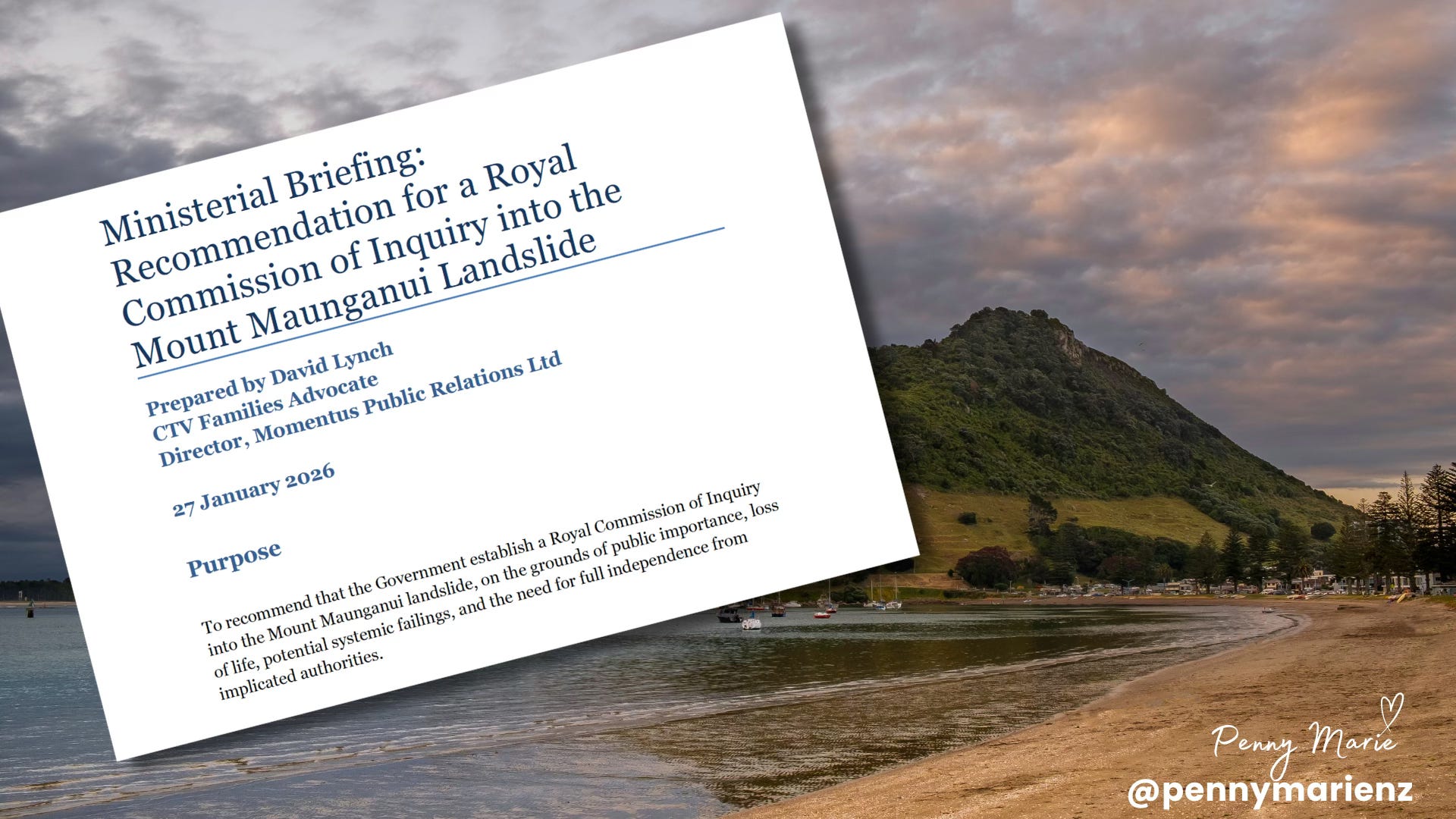
The Case for a Royal Commission Inquiry into the Mount Maunganui landslide
A new ministerial briefing from CTV Families advocate David Lynch urges NZ Prime Minister to establish a full Royal Commission into the Mt Maunganui landslide – not another council‑managed review.
On Tuesday afternoon, as Parliament paused to acknowledge the six lives lost at Mount Maunganui, a familiar voice from Christchurch quietly put something weighty on the Prime Minister’s desk.
David Lynch, long‑time advocate for the CTV Families Group, has formally asked Christopher Luxon to establish a Royal Commission of Inquiry into the Mt Maunganui landslide – and not allow Tauranga City Council to run an “independent review” of decisions in which it may be centrally implicated.
Who is asking for a Royal Commission?
Lynch writes in his briefing as both director of Christchurch‑based Momentus Public Relations and as advocate for the CTV Families Group, representing the 115 victims of the CTV building collapse in the February 2011 earthquake.
Lynch reminds Ministers that, nearly 15 years on, CTV families still have “no justice, no accountability, and no closure” – and warns that Mount Maunganui families risk being put through the same slow grind if early decisions lack independence and transparency.
This is not a random lobbyist inserting himself into a tragedy. This is the same advocate who has watched, up close, how institutions close ranks, how “reviews” are carefully bounded, and how families are managed rather than heard.
What Lynch has asked Luxon to do
Lynch has framed his request as a ministerial briefing and recommendation, not just a media op‑ed.
It is addressed to the Prime Minister Christopher Luxon, and copied to Ministers Mark Mitchell, Judith Collins, Simon Watts, Chris Penk, and party leaders Winston Peters and David Seymour, along with local MPs for Bay of Plenty, Ilam, and Banks Peninsula and CTV spokesperson Professor Maan Alkaisi.
Its purpose is explicit: To recommend that the Government establish a Royal Commission of Inquiry into the Mt Maunganui landslide on the grounds of public importance, loss of life, potential systemic failings, and the need for full independence from implicated authorities.
“A single, comprehensive, and fully independent inquiry is in the best interests of the families and the wider public. It is the only credible pathway to a full, fair, and unimpeded examination of the issues.” - Ministerial Briefing, Lynch
Why a council‑run “independent review” is not enough
Key points from the briefing:
Tauranga City Council has already announced its own “independent review” into events leading up to the landslide.
At the same time, there are early concerns about council‑commissioned slope‑instability reports, hazard mapping decisions, and how warnings – including a smaller 5am slip – were handled.
Lynch argues that where the council may be implicated in hazard identification, land‑use decisions, or emergency response, it “cannot credibly investigate itself”.
This is the oldest move in the playbook. The same authority that signed off hazard maps, consents and emergency plans now wants to badge its own process as “independent”, while the public is still in shock and the families are still waiting for their dead to be brought home.
Even if everyone involved acted in good faith, perception matters: you cannot restore confidence with an inquiry that reports back to the very council whose decisions are under question.
Does Mt Maunganui meet the Royal Commission test?
Lynch structures his briefing around the usual criteria for a Royal Commission and walks through each of them:
Lynch sums it up bluntly: a Royal Commission is justified when lives have been lost, there are allegations of systemic or regulatory failure, the implicated authority cannot credibly investigate itself, public confidence requires independence, and the issues are complex and nationally significant.
He states that the Mt Maunganui landslide meets all of these criteria and recommends Cabinet urgently approve a Royal Commission with wide‑ranging terms of reference.
What a Royal Commission would need to examine
From the briefing, the recommended terms of reference include:
Hazard identification and mapping at and around the Mount, including why the fatal slip area was outside mapped hazard zones.
Land‑use decisions and regulatory oversight, including consents, monitoring, and how known slope‑failure and subsidence risks were managed.
Emergency response actions: early‑morning slip reports, warnings, access to the campground, and the timing and adequacy of official responses.
Governance, accountability and systemic risk management across Tauranga City Council and any relevant agencies.
Contributing environmental, geological and infrastructural factors.
Put simply, the question is not just “why did the hillside move?” It is “who knew what, when, and what did they do with that knowledge?”
That is the same question that still hangs over the CTV collapse, and it is why the CTV families are now standing alongside families at the Mount.
Echoes of CTV – and a warning from Christchurch
Lynch draws on 14 years of working with Professor Maan Alkaisi and the CTV families, describing how easily families can be sidelined when “institutional systems close ranks”.
He notes that CTV families have had to fight for every scrap of information, and that the absence of early, truly independent decision‑making has contributed to their lack of justice and closure.
Christchurch families know better than anyone what happens when governments rely on narrow terms of reference, polite internal “reviews” and slow, legalistic processes to bury hard questions. The warning coming from that city today is clear: do not make Mt Maunganui families walk the same 15‑year road.
Where this goes next – and what to watch for
The government now has a clear choice: either establish a single, comprehensive, independent Royal Commission, or back a fragmented set of inquiries in which Tauranga City Council remains at the centre of its own investigation.
Watch mainstream media and Beehive media release, and hold them to account. If you have expertise in the areas and can tell the public what is going on, please, use your voice. Don’t expect the media to do the heavy lifting for you. Our Prime Minister Christopher Luxon said in this recent statement “...the people in the margins with their rhetoric, they just need to, you know, frankly, keep it to themselves and focus on doing everything they can to support the community at this time”.
New Zealanders should pay close attention to how quickly the Beehive moves and which model of accountability it chooses. If the Government is serious about learning from CTV, it will not leave this in the hands of a conflicted local authority and a carefully‑worded “independent review”.
Read my previous posts with citizen reports and analysis on the Mt Maunganui landslide…
Mount Maunganui Was Not an “Unprecedented” Disaster It Was an Authorised One
But first, a word from me...
About Penny Marie
I am an independent researcher and reporter. I survive and thrive on the support of people like you. If you would like to support me, I’d really appreciate you, thank you!
- One-off support of $10 or more
- Monthly support: $10, $25, $50, $100, $250, $500.


Another Royal Commison, forgive my cynicism but in difficult issues these Commisons always seem to soften judgement, bury the issues and present a "Truth" that buries the real facts