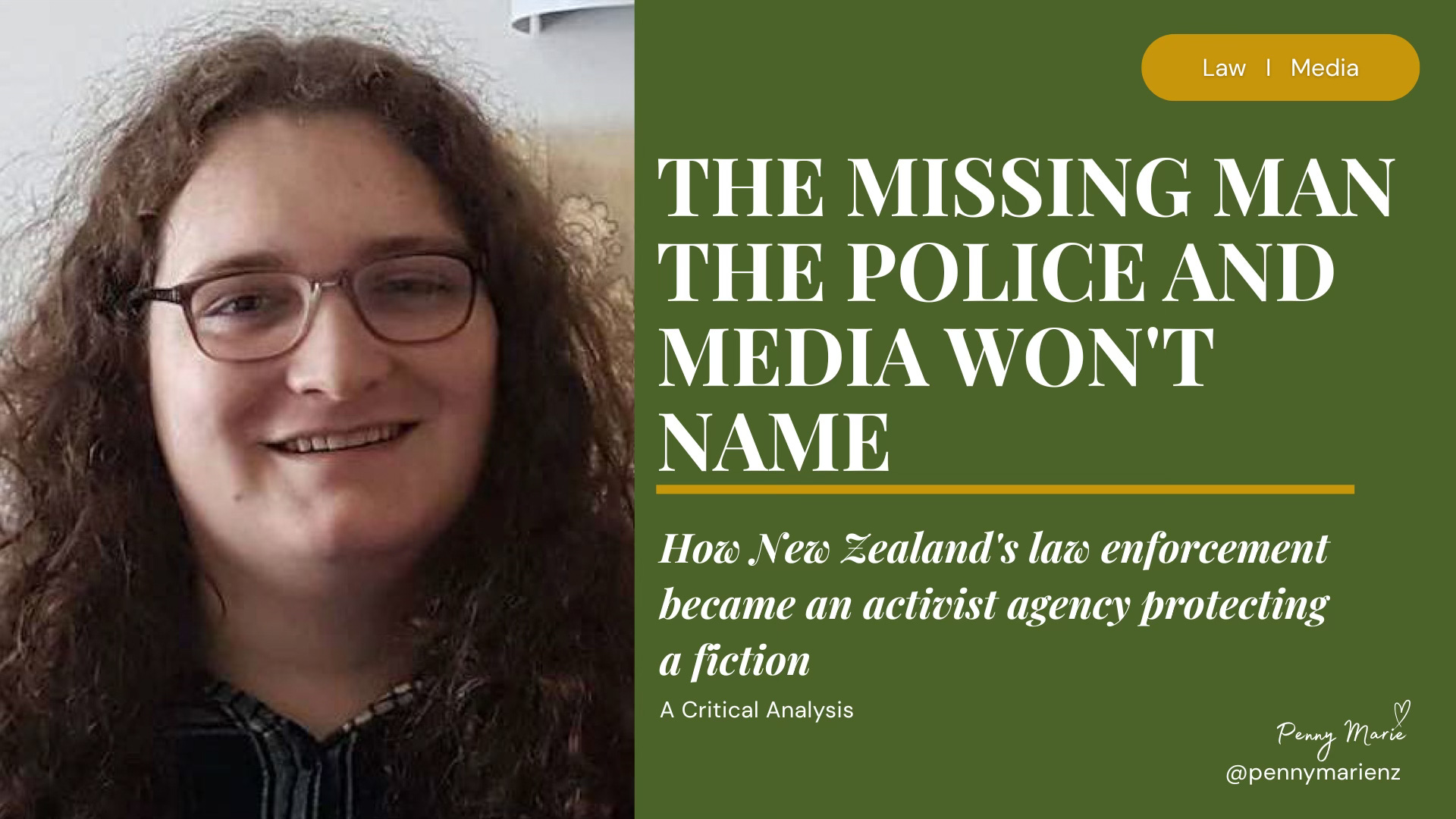
The Missing Man The Police And Media Won't Name
How New Zealand's law enforcement became an activist agency protecting a fiction, and the media reinforces the deception
Authors note: The intention of this article is to ensure the safety of the missing person, and raise awareness that our police, law and media are hamstrung to do the best by victims and vulnerable people. They cannot do this when ideology takes preference over facts.
When a person goes missing in New Zealand, we rely on two institutions above all others to tell us the truth: the police, and the press.
This week, both failed.
A biological male has gone missing in Wellington. The police are calling him a woman. The media are calling him a woman. And under the laws that a small, government-funded activist network lobbied into existence, they are both legally compelled to do so.
This is not a story about one missing person. This is a story about what happens when the agency tasked with protecting every New Zealander becomes an activist agency protecting an untruth.
The appeal
Wellington Police issued a missing persons appeal for “Amber Bohanna,” described as a woman from Karori. The NZ Herald published it without question, using she/her pronouns throughout.
Amber Bohanna is a biological male.
His biological sex is directly relevant to a public safety alert. Physical description, risk profile, likely social environments - all shaped by biological reality. Replacing that with a legal fiction does not protect the missing person. It protects an ideology. And it potentially hampers the ability of the public to assist in finding him.
The police are not doing this out of malice. They are doing it because the law now demands it, the institutional culture enforces it, and anyone who departs from the script risks complaint, investigation, or worse. The Conversion Practices Prohibition Legislation Act 2022 and the amended Births, Deaths, Marriages and Relationships Registration Act 2021 have together created a legal environment in which the police - New Zealand’s primary public safety agency - cannot accurately describe a biological male in a missing persons bulletin without potential legal and political exposure.
That is the chilling, concrete, real-world consequence of laws built not on public need, but on activist lobbying. And the man at the centre of this case was part of that lobby.
Amber Bohanna’s InsideOut connection
According to InsideOut Kōaro’s own 2019/20 Annual Report, Amber Bohanna served as Treasurer on the Board of Trustees of InsideOut - one of New Zealand’s most politically influential transgender lobby organisations, operating inside schools and alongside government.
In his own Treasurer’s Reflection in that report, he named InsideOut’s funders: the Ministry of Youth Development, COGS, CAYAD, Lotteries Commission, and the Wellington City Council. Public money. Flowing to an organisation running school workshops, co-producing resources for health professionals, and lobbying Parliament for the very laws now protecting his legal identity in a police bulletin.
InsideOut celebrated when the Conversion Practices Prohibition Bill passed its first reading in August 2021. Introduced 29 July 2021, passed in six months, Royal Assent 17 February 2022. Minimal public debate. Years of groundwork by activists, culminating in legislation rushed through under the previous Labour government.
Amber Bohanna was part of the governance structure of the organisation that helped make that happen, he oversaw the books that funded the activism.
The network: InsideOut, Gender Minorities Aotearoa, and the state
During Bohanna’s tenure as Treasurer, InsideOut co-produced a guide titled Supporting Aotearoa’s Rainbow People: A Practical Guide for Mental Health Professionals in direct collaboration with Gender Minorities Aotearoa (GMA), RainbowYOUTH, and a Victoria University researcher. Hosted at rainbowmentalhealth.nz, this resource was distributed to counsellors and therapists nationwide - pre-emptively reshaping clinical culture to demand gender affirmation before the Conversion Practices Act legally mandated that approach.
The therapy sector was captured before the law arrived. The law then locked that capture in permanently.
In 2024, GMA published a document titled Anti-Transgender Extremism - funded by the New Zealand government’s Community Matters Preventing and Countering Violent Extremism Fund. The same counter-terrorism infrastructure built to prevent radicalisation was directed at funding a political document by a lobby group based at 130 Riddiford Street, Newtown, Wellington.
I investigated and podcasted on this document at length. You can check out my full exposé here, including interview on The Platform with Sean Plunket:
They have named YOU as the extremist
The GMA Anti-Transgender Extremism guide deserves your full attention, because it reveals the strategy plainly.
The document classifies the following as markers of extremism:
Using the phrases “think of the children”, “protecting women”, or “gender ideology” - described as dangerous coded language
Carrying out “transphobic research, academia, policy writing, or influencing how society is run in other non-illegal ways”
Advocating restrictions on puberty blockers for children
Believing in two biological sexes
Most strikingly, it states that “covert” anti-trans extremists - those who write, research, publish, and advocate - are more dangerous than those who commit physical violence, because they are more likely to “recruit others, influence society, and undermine human rights protections.”
My investigative journalism. A parent at a school board meeting. A counsellor who suggests a distressed teenager explore their feelings before pursuing irreversible medical intervention. All of it - classified, in a taxpayer-funded counter-terrorism document, as a form of extremism more dangerous than physical violence.
This is not a fringe pamphlet. It is a deliberate architecture of pre-emptive censorship. By labelling dissent as extremism before debate can occur, the lobby removes the possibility of honest public conversation. It is a strategy designed by people who know they cannot win on the evidence.
And it was produced by the same organisation that collaborated with the group whose Treasurer is now the subject of a police missing persons appeal - a police appeal that, thanks to their laws, cannot state his biological sex.
What we believe - and why truth is not hate
I want to say this plainly, because the entire strategy of this lobby depends on misrepresenting it.
Those of us who advocate for repealing the Conversion Practices Act and correcting the BDMR do not hate trans-identifying people. We do not want them to suffer. We do not want them to come to harm.
We want them to be told the truth - because without truth, there is no genuine care. We want them to get the help they need and see them as positively contributing members of society.
The evidence is consistent: People who identify as ‘transgender’ carry significantly elevated rates of co-occurring mental health conditions - depression, anxiety, autism spectrum disorder, trauma, and dissociation. These are clinically significant. They are not resolved by changing a name on a birth certificate or compelling everyone around a person to adopt a fiction. They require honest, compassionate, exploratory care - the very kind the Conversion Practices Act now makes legally dangerous to provide.
When society legislates around a distressed person’s delusion rather than addressing its roots, it does not heal them. It builds an entire legal and social infrastructure around their pain and calls it progress. It punishes anyone - a parent, a teacher, a journalist, a counsellor who gently tells the truth.
A society that legislates lies does not become more compassionate. It becomes more brittle, more dishonest, and ultimately more dangerous - most of all for the people it claims to protect.
I explored this at length in Defining Women Without Fixing the Problem. The crisis in how we define and protect women is real. But we will never fix it by first agreeing to pretend men are women.
When the Police protect a fiction, everyone is less safe
Return to the missing persons case.
A biological male is missing. The police cannot accurately describe him. The media will not. The public - who might recognise him - are being given a description shaped by ideology rather than reality.
The system these activists built is now working against the goal of finding a vulnerable person. That is not a theoretical consequence of bad law. That is the real-world, immediate, human cost of institutional capture.
The police are not villains here. They are trapped - by law, by culture, and by the fear of what happens if they depart from approved language. That is precisely why these laws must be repealed. Not only because they corrupt public discourse, and not only because they silence journalists and counsellors and parents. But because they have now demonstrably compromised the ability of New Zealand’s primary safety agency to do its job.
I hope Amber Bohanna is found safely. I hope he receives the genuine care and support that his situation clearly calls for.
But his safe return does not close this story. This story closes when the laws that erased his biological reality from a police alert are repealed. When the network of publicly funded organisations that built those laws - InsideOut, Gender Minorities Aotearoa, and their government backers - are held publicly accountable. And when New Zealand’s police can once again do what we ask of them above everything else:
Tell the truth.
Penny Marie
Penny Marie is a New Zealand-based advocate for sex-based rights and strong families. She formed Let Kids Be Kids in 2023. Penny is currently overseas working with international counterparts on this very topic, please follow, comment, share and support her.


Thank you for bringing this to light.