Women’s Rights, Rebranded: How UN “Gender Equality” Is Undermining New Zealand Women
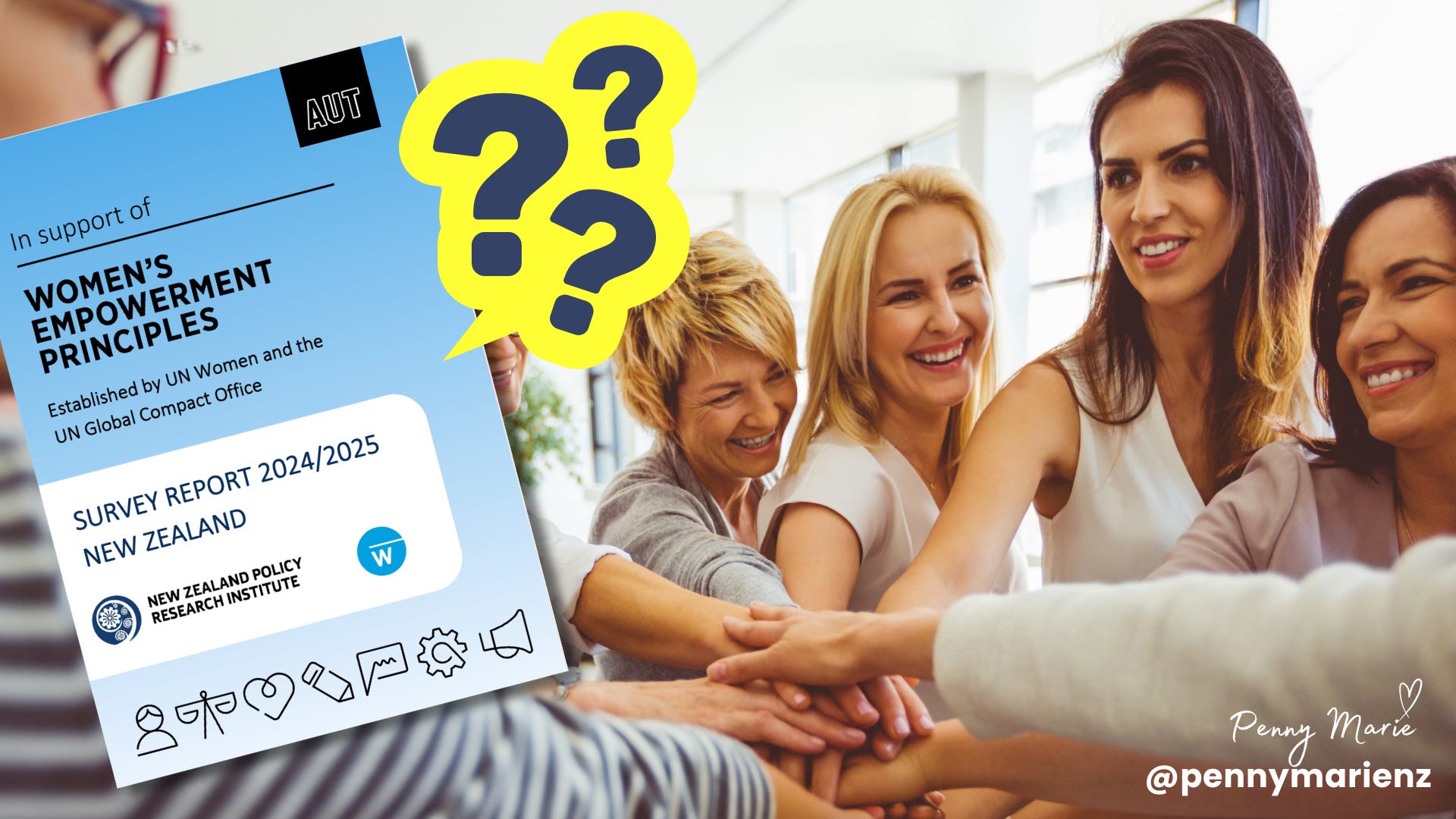
I came across a document ‘WOMEN’S EMPOWERMENT PRINCIPLES’. The article below unpacks its intention, influence, and New Zealand law firms who have signed on to the related 'Gender Equality Charter'...

New Zealanders are being told that “gender equality” is about helping women – but when you read the fine print of the frameworks our institutions have signed up to, a very different story emerges.
At the heart of this shift is a quiet but radical change in definition: women no longer means adult human females. It now routinely means “women, including those who identify as women” – that is, anyone of either sex (there are only two) who adopts the label.
Once this move is made, every policy, quota and leadership target supposedly “for women” becomes a mixed bag. Biological sex – the reality that underpins pregnancy, childbirth, breastfeeding, menopause and female‑pattern discrimination – disappears behind the fog of “gender identity”.
“This report aims to provide …benchmarking of progress over the reporting period, for the participation of women (including those that identify as women) across our organisation.” - page 11 of Women’s Empowerment Principles (WEPS) report.
This isn’t just wordplay. It reshapes who gets counted, who gets promoted, and who is allowed to speak for “women” in public life.
What is ‘gender equality’ under UN SDG 5 and WEPs?
The United Nations’ Sustainable Development Goal 5 (SDG 5) – “Gender Equality” – and the UN Women’s Empowerment Principles (WEPs) are presented as neutral tools to advance women in work and leadership. In New Zealand, these frameworks underpin surveys, policies and charters – including the 2024–2025 NZ WEPs Survey Report and the New Zealand Law Society’s Gender Equality Charter – which claim their “primary purpose is to improve the retention and advancement of women.”
The NZ WEPs survey describes itself as uncovering “policies and practices within New Zealand’s signatory organisations” across seven WEPs, from leadership and equal opportunity to community and reporting.
The Gender Equality Charter (GEC) FAQ states that “gender equality is critical to the success and sustainability of the legal profession,” and is explicitly designed “to support and encourage the legal profession to improve the retention and advancement of women lawyers.”
“The primary purpose of this charter is to improve the retention and advancement of women in the legal profession.” - Gender Equality Charter FAQ
On the surface, this all sounds straightforward. The problem is how “gender” and “women” are actually being used.
From sex to ‘gender 'identity’: How definitions are being rewritten
Once you move past the sales pitch, the wording shifts.
The NZ WEPs survey includes the key clause that it is measuring the participation of “women (including those that identify as women).”
Participating organisations are praised for promoting “a culture that is safe, respectful and inclusive for all genders,” and for embedding gender‑identity language into women’s development programmes and equality strategies.
The Law Society’s Gender Equality Charter constantly pairs “gender equality” with “inclusion,” and is supported by a suite of “gender lens” tools, unconscious‑bias training and diagnostic resources drawn from the broader DEI/SDG5 ecosystem.
“The Charter is open to the whole legal profession…to demonstrate their commitment to gender equality and inclusion.” - Gender Equality Charter FAQ
This is not a neutral update in vocabulary. It is a deliberate re‑engineering of the category on which women’s rights were built. If “woman” is now defined by self‑identification, then sex‑based protections and opportunities become porous, and every “women’s” leadership statistic becomes ambiguous.
When an organisation says it has lifted “women’s representation in leadership” to 40 or 50 percent, the public quite reasonably assumes that means female representation. Under the new ideology, you have no way of knowing how many of those counted as “women” are men who identify as women.
At the NZ First Convention in 2025 I spoke about how ‘sex’ became ‘gender’ in law and why we need to know…
Women’s Place in Society: Why One-Size-Fits-All “Equality” Fails
There is a second distortion baked into this model: it treats women’s liberation as if it begins and ends with matching men’s outcomes in senior jobs.
The WEPs report and the Gender Equality Charter are overwhelmingly focused on women in partnership, directorship and executive roles, alongside pay gaps and promotion metrics. For some women, that matters deeply – and they should not face discrimination. But it is not how many women live.
In the real world:
More mothers than fathers stay home with babies and toddlers, or reduce hours to keep families functioning.
Women have historically been the backbone of communities – running committees, clubs, charities and informal networks that hold society together.
Many women want balance, not endless escalation: fair paid work, yes, but also time and energy for children, partners, elderly parents and community life.
Yet the “gender equality” framework largely ignores this. Its implicit model of success is a woman whose working life is virtually indistinguishable from that of a child‑free male executive – and if she cannot or will not live like that, the problem is framed as bias or “barriers,” not as a legitimate difference in priorities.
There is no evidence that all, or even most, women want to be equal to men in all things in the workplace. Many working women would voluntarily cut back their hours if they could afford it. Many would choose a secure, reasonably paid part‑time role over a brutal climb to the top. Yet being a full‑time “career woman” has been sold as a status symbol, while the work of mothers and carers is quietly devalued.
Who suffers? Families, children and communities – and often women themselves – when cultural and economic pressure pushes mothers into full‑time work as the only respectable option, while the state or strangers pick up early‑years care.
I spoke about motherhood at Moms For America press conference, in Washington, October 2025…
Who really benefits from ‘gender equality’ policies?
So who gains when the word “woman” is uncoupled from sex and when empowerment is defined purely as corporate seniority?
It is not the mother juggling part‑time work, school runs and elder care.
It is not the woman who wants a sane, balanced life that values both income and caregiving.
It is certainly not girls being edged out of female‑only scholarships, spaces, and development programmes by a mix of identity politics and target‑driven HR.
The real beneficiaries are:
Institutions that can hit “gender” targets without asking hard questions about hours, culture, or the value of care work.
Men who identify as women, who are able to access “women’s” policies, quotas and programmes that were originally designed to address sex‑based disadvantage.
The DEI industry – consultants, trainers, accreditation bodies – whose influence and revenue grow with every new charter, “lens” and dashboard.
On paper, the numbers look better. In practice, the realities for many women – especially mothers, carers and women who hold to biological reality – change very little, and sometimes worsen.
WEPs, SDG 5 and the 40:40:20 illusion of progress
Consider the widely promoted “40:40:20” leadership model referenced in the WEPs survey: 40 percent women, 40 percent men, 20 percent “any gender.”
“[Our organisation] has publicly committed to gender equality and women’s participation in leadership via its annual reporting and via our partnership with Global Women, Champions for Change where we commit to 40:40:20 targets for women in leadership…40% women, 40% men, 20% any gender.” - WEPs 2024-2025 report
It sounds balanced – until you remember that:
“Women” explicitly includes males who “identify as women,” and
“Any gender” can also include males.
There is no clear minimum for female representation. In theory, a significant share of the “40% women” and all of the “20% any gender” could be male.
The NZ WEPs report actively celebrates organisations that:
Use WEPs as their strategic framework for gender equality work.
Bake WEPs language into HR, recruitment and pay‑equity policies.
Report “women’s” participation and pay‑gap metrics that explicitly include “those that identify as women.”
The Law Society’s Gender Equality Charter does something similar for the legal profession. It acknowledges that women are the majority of graduates and of the profession, but under‑represented in senior roles, then runs all its solutions – unconscious‑bias training, gender pay audits, flexible working, equitable briefing – through a “gender equality and inclusion” lens.
“Signing up to the charter provides signatories with a framework to help them in their efforts to improve gender equality and inclusion in their workplace and the wider legal profession.” - Gender Equality Charter
Once sex is replaced with “gender identity,” the data becomes foggy. The profession and the public are told that gender gaps are closing for “women,” while the key question – are female lawyers in all their diversity actually gaining ground? – is left unanswered.
DEI, equity matrices and the decline of merit
Layered on top of this is the now‑ubiquitous DEI (Diversity, Equity, Inclusion) machinery. In practice, it often means:
Hiring and promotions driven by an equity matrix – ticking identity boxes (gender, identity, ethnicity, etc.) – rather than by skill, experience and temperament.
Staff watching roles filled as “diversity hires” and correctly concluding that merit is no longer the sole currency.
Growing cynicism and disengagement among good, hard‑working people who are told their concern for meritocracy is evidence of “privilege” or “fragility.”
WEPs and SDG5‑aligned policies integrate seamlessly into this model: senior roles and board seats become tools for managing identity‑based optics as much as for ensuring competence and service to the public.
Over time, this can only damage institutional performance. When key decisions are made by people selected to satisfy external metrics rather than for their proven judgement and skill, the quality of governance falls – with real‑world consequences for staff, customers and the economy.
Silencing dissent: When biological reality becomes “hate”
Perhaps the most telling piece of this puzzle is how dissent is handled.
Anyone who says:
Sex is real and matters.
Women are female.
Mothers’ caregiving and community work are vital.
Female‑only spaces, data and opportunities should exist.
…is quickly dismissed as “bigoted,” “far right,” “transphobic” or “anti‑progress.”
This framing is powerful because it scares off precisely the people who most need to be in the conversation: thoughtful men and women who believe in basic fairness, biological reality and the value of family life, but who do not want to risk their careers or reputations.
Meanwhile, the rearrangement of language, policy and power continues quietly – via UN‑aligned frameworks, professional charters and HR manuals that most New Zealanders never see.
Call to action: What men and women in New Zealand can do
This is not a niche “culture war.” It goes to the heart of what kind of country we want to be.
If we accept that:
“Woman” no longer has a clear, sex‑based meaning; and
“Equality” for women only counts when it looks like a male‑pattern career;
…we marginalise many women’s own aspirations, erase sex‑based realities, and corrode trust in institutions.
You do not have to accept that trade‑off.
For women:
Ask your employer, professional body or union how they define “woman” and “gender” in policies, targets and reporting. Demand sex‑based data alongside any “gender” metrics.
Insist that women’s spaces, programmes and opportunities are truly female‑only, and that motherhood, caregiving and community work are recognised as valuable paths – not obstacles to “real” success.
Share information – including documents like the NZ WEPs survey and the Gender Equality Charter – with other women, and talk openly about what these frameworks actually do.
For men:
Support the women in your life – partners, sisters, colleagues, daughters – who want sex‑based reality acknowledged and family life valued.
Speak up, respectfully, when you see language games being used to obscure basic truths or when merit is sidelined in favour of identity metrics.
Refuse to participate in tokenism: if you are offered a role simply because you tick or don’t tick a box, say so.
For all New Zealanders:
Read the source documents. The NZ WEPs survey, the New Zealand Law Society’s Gender Equality Charter, and the list of charter signatories are publicly available via the Law Society and related sites.
Ask your organisations – public and private – to be honest and transparent about definitions, data and trade‑offs.
Support spaces, services and policies that recognise both biological reality and the many different ways women contribute to society, including as mothers and community anchors.
New Zealand is capable of extending courtesy and legal protections to everyone without redefining women out of existence, sidelining mothers, or turning the country into a DEI spreadsheet. That begins with plain speech and a shared insistence on reality.
Penny Marie
Your support is extremely appreciated thank you! One-off support of $10 or more, Monthly support: $10, $25, $50, $100, $250, $500


Thank you for this clearly written and highly significant article.
Many points to reflect on. Language to be challenged. Metrics to serve international corporations and that don’t adjust to every nation’s reality or culture. Trying to square the circle to fit into foreign policies.