
Merit Is Now The Law. D.E.I. Is Not
A Critical Analysis: The new Public Service Amendment Act 2026 changes, what it means and who can we thank?


Something significant just happened in New Zealand law
Before 3 June 2026: All NZ Public Service agencies were required by law to run DEI programmes.
After 3 June 2026: These agencies are no longer required to run DEI programmes - but running them voluntarily is not prohibited.
The Public Service Amendment Act 2026 received Royal Assent on 2 June 2026. It came into force on 3 June 2026.
For the first time since 2020, the law that required every government department in New Zealand to run Diversity, Equity and Inclusion (DEI) programmes - programmes built in part on the ideological architecture of the Yogyakarta Principles - has been STRUCK FROM THE STATUTE BOOKS.
How did DEI get flushed through our government departments in the first place?
The Public Service Act 2020 - the law whose DEI provisions have just been repealed - was introduced to Parliament by Labour’s Chris Hipkins, then Minister of State Services. Hipkins described it as… “…the most significant change in the public service in 30 years.” - in a Beehive Statement on 23 July 2020.
The diversity and inclusiveness obligations embedded in sections 73 and 75 - the provisions now repealed - were Labour’s design, driven by Labour, and celebrated by Labour.
The significance of Section 75
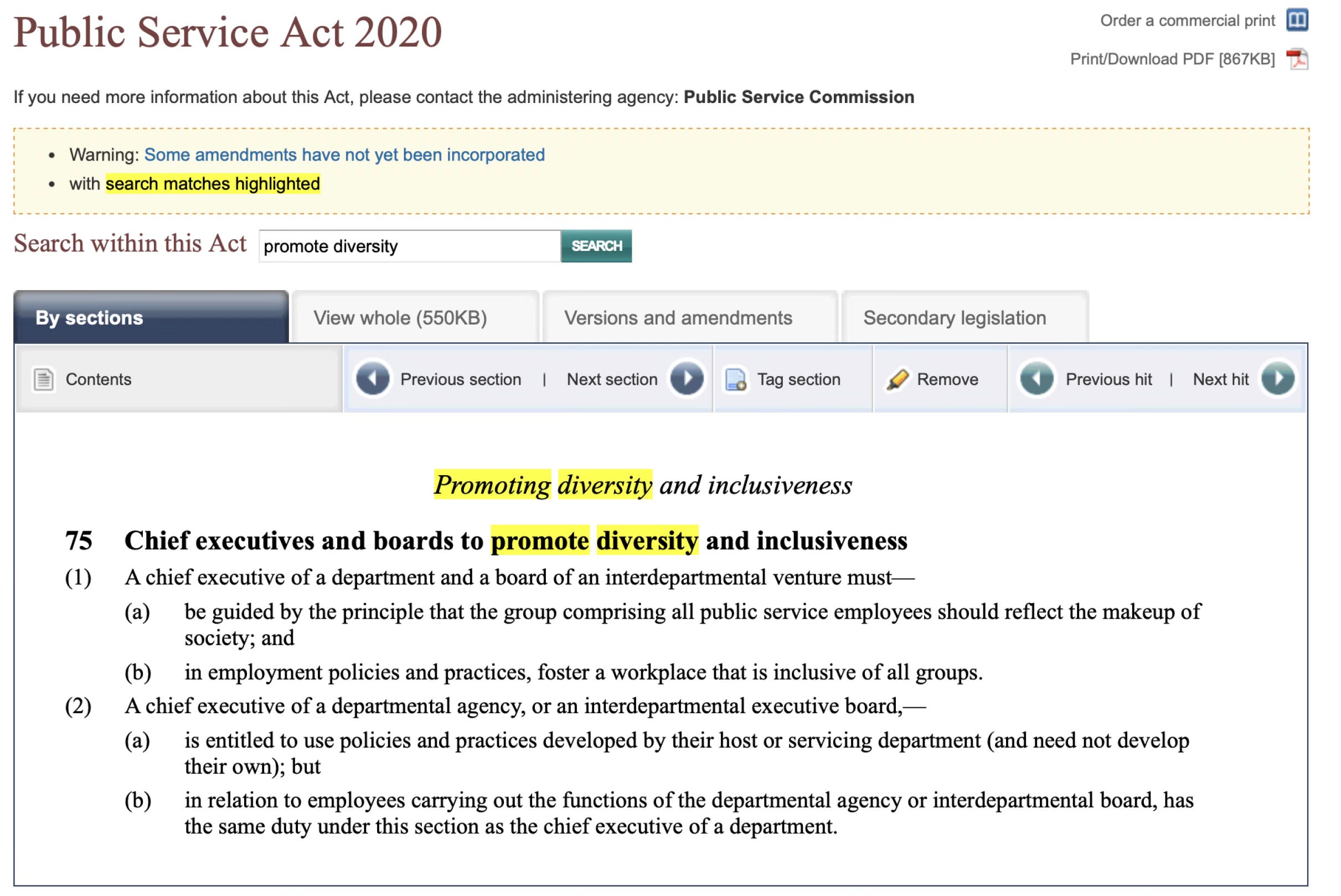
Section 75 of the Public Service Act 2020 - the provision just repealed - read as follows:
“A chief executive of a department must - (a) be guided by the principle that the group comprising all public service employees should reflect the makeup of society; and (b) in employment policies and practices, foster a workplace that is inclusive of all groups.”
The word “must” is the operative word. Not guidance. Not aspiration. A binding legal obligation on every public service chief executive in New Zealand.
When the Ministry of Health cited “the Public Service Act 2020 (specifically sections 73 and 75)” as the legal authority for its Whiria te Tangata DEI strategy, it was complying with the law.
When DPMC funded six taxpayer-funded Employee-Led Networks - including a dedicated Rainbow Network - it was operating within a legal mandate
When ‘unconscious bias’ training was made mandatory at government induction
When ‘pronoun’ fields appeared on public service job applications
When ‘gender affirmation’ guidance was embedded in leadership programmes across every major department
…all of it had legal authority - derived from sections 73 and 75 of the 2020 Act.
From 3 June, those sections have been repealed.
How did this Act become law?
The voting record on the Public Service Act 2020 was as follows:

In August 2020 New Zealand First was in coalition with Labour. They voted the DEI mandate within the Public Service Act into law. The Yogyakarta-influenced sections 73 and 75 - the sections now repealed - passed with NZ First’s vote.
Who gets the credit for the new amendments?
This week, New Zealand First published a statement about the Public Service Amendment Bill featuring Winston Peters quoted as saying:
“This Bill would put an end to the woke left-wing social engineering and diversity targets in the public sector. New Zealand is a country founded on meritocracy not on some mind-numbingly stupid ideology.” - Winston Peters, on New Zealand First’s Member’s Bill to scrap DEI in the Public Service
Beneath the quote, NZ First’s email states: “This week, the Public Service Amendment Bill passed in parliament. This Bill includes the removal of ‘Diversity, Equity & Inclusion’ (DEI) requirements from the public service after a push from New Zealand First last year to scrap DEI requirements.”
Yet they were coalition partners with Labour in 2020 that gave us the DEI mandate in the first place.
NOTE: At the time of publishing this story I am awaiting comment from New Zealand First.
Who repealed it - and how
In March 2025, New Zealand First introduced a Member's Bill - the Public Service (Repeal of Diversity and Inclusiveness Requirements) Amendment Bill. That bill proposed removing the DEI obligations from the Public Service Act. It was not a Government Bill. It was never drawn from the ballot. But it demonstrates their change of heart.
The Government Bill that did become law - the Public Service Amendment Act 2026 - started as a National-ACT Government Bill. It was introduced by then-Public Service Minister Judith Collins on 28 July 2025, as a fulfilment of the National-ACT Coalition Agreement, to 'amend the Public Service Act 2020 to clarify the role of the public service, drive performance, and ensure accountability.'
Neither coalition agreement explicitly committed to removing DEI provisions. The DEI repeal provisions were added during the parliamentary process - reflecting NZ First's advocacy on the issue through its own Member's Bill. The provisions were passed with support from all three coalition parties.
National and ACT were the architects of this legislation.
They are also the parties who voted against the original DEI mandate in 2020.
NZ First is the party that voted to bring the DEI mandate in, and now, they are the ones supporting their coalition parties to get it out. After 5 years of embedded DEI programmes across the public service.
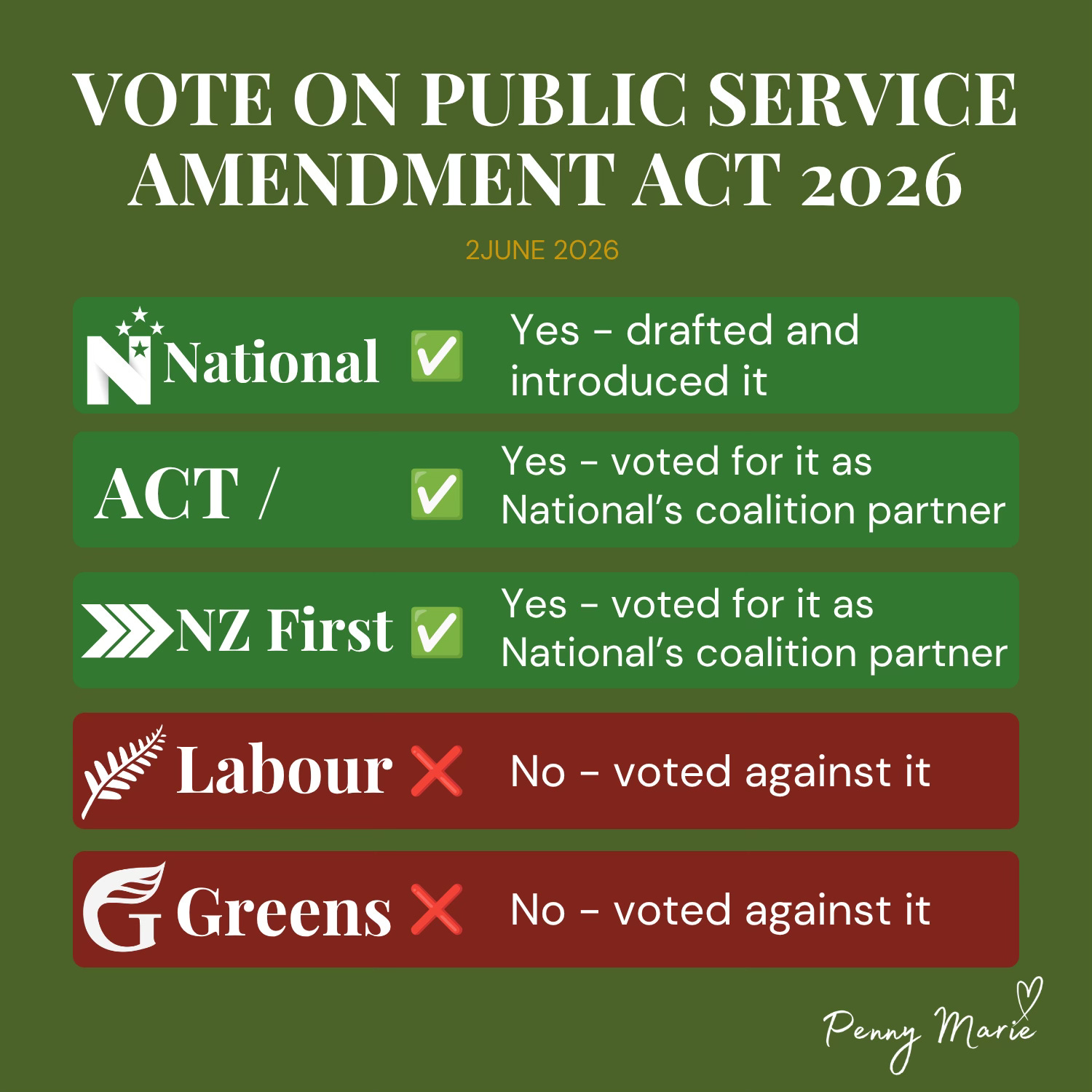
Three-party coalition in unison
During the parliamentary process, the National-ACT Government Bill was amended to incorporate the substance of what NZ First’s Member’s Bill had proposed - the specific repeal of the DEI provisions. NZ First supported and advocated for those amendments. All three coalition partners voted for the final bill.
When NZ First’s communication says the bill passed “after a push from New Zealand First,” it is technically careful. The push was real. But the vehicle was not NZ First’s. The party that drafted, introduced, and owns this legislation is National, in coalition with ACT. NZ First is a supporting actor in this story - not the lead.
And it is the party that enforced the DEI mandate in 2020 with Labour.
Let Kids Be Kids raised concerns about the Public Service Act in relation to the Yogyakarta Principles, in June 2025

In June 2025, I presented a Let Kids Be Kids white paper, co-published with Lesbian Resistance - The Yogyakarta Principles And Their Influence On The Public Service DEI Plan 2024-2025 - along with a second paper on Conversion Practices - at the National Citizens’ Inquiry in Canada. The DEI paper specifically raised the issue of the Public Service Act and its direct links to the Yogyakarta Principles (I also spoke about these principles at the NZ First Convention in September 2025).
We traced the precise upstream source of the DEI mandate in the New Zealand public service - not as vague ideology, but as a specific, documented pipeline from a non-binding UN instrument - the Yogyakarta Principles, through international advocacy channels, into the text of sections 73 and 75 of the Public Service Act 2020. The report was sent to a New Zealand First parliamentary staffer on 7 July 2025 - three weeks before the Government bill was introduced on 28 July 2025.
We did not make a formal submission to the Governance and Administration Select Committee when this bill went through Parliament. Submissions closed on 30 August 2025 - a process I was not tracking at the time, having been focused on grassroots advocacy and public education rather than parliamentary procedure.
Watch Penny Marie testify at the National Citizens’ Inquiry, Canada - full report available to download
Whether our research contributed to the shape of the legislation is a question I do not know. Perhaps the timing of our report may have mattered to this process. Our research for the past 12 months has consistently highlighted how the Yogyakarta Principles - which are non-binding - have significantly influenced law and policy in NZ - The Public Service Act 2020 being one example, and a significant one at that.
What the Amendment Act actually removes
These changes are effective from 3 June 2026:
Section 75 - repealed. The duty to make the public service “reflect the makeup of society” and foster DEI-inclusive workplaces is gone entirely.
Sections 73(2), (3)(i) and (3)(j) - stripped back. “Good employer” obligations no longer require diversity representation programmes or ideologically-framed inclusion architecture.
Section 44(c) - amended. The Public Service Commissioner’s duty to build a “diversity-reflecting” workforce is removed. The function is now discretionary, not mandatory.
Schedule 7 - amended. “Diversity and inclusiveness” removed as a criterion for appointing public service chief executives. Merit is now the sole statutory criterion.
Section 97(2)(e) - amended. Government workforce policy statements are no longer required to include DEI content.
Every government agency’s annual DEI plan, mandatory rainbow inclusion targets, compulsory bias training, and diversity-based hiring frameworks have now lost their legal foundation.
Does this change things in Health and Education?
Healthcare
The Ministry of Health and Health New Zealand (Te Whatu Ora) are covered by the Public Service Act as Crown agents. The repeal of sections 73 and 75 directly removes their statutory obligation to maintain rainbow representation targets, fund LGBTQ+ Employee-Led Networks as a legal requirement, or apply rainbow-specific criteria in hiring and promotion.
Where health services or internal programmes were justified as a DEI obligation under sections 73 and 75, that justification is now removed. Clinical services required under separate legislation remain.
What has been removed is the ideological DEI mandate layered on top. Whether agencies choose to continue particular services under separate clinical or policy pathways is an ongoing question that warrants its own scrutiny.
Education
The Ministry of Education as a public service department is covered by the Amendment Act. However, schools, the curriculum framework, and teacher training are governed primarily by the Education and Training Act 2020 - which is not affected by this bill.
The RSE (Relationships and Sexuality Education) Framework, the UNESCO-aligned sexuality education content in classrooms, and the taxpayer-funded NGO programmes - including InsideOut - that facilitate ‘gender identity’ training in schools are not directly repealed by this Act. They operate through Ministry of Education policy and separate funding channels.
What has not changed
The following remain fully in force today:
The Births, Deaths, Marriages and Relationships Registration Act 2021 - self-identification of legal sex remains law
The Conversion Practices Prohibition Legislation Act 2022
The Ministry of Education RSE Framework and UNESCO-aligned sexuality education in schools - with MOE Endorsed ‘Navigating The Journey’ resources by Sexual Wellbeing Aotearoa (Family Planning) still being used in schools. Schools are told that these resources fit within the 2007 Health Curriculum Guidelines that are the current standard… but they far overreach these expectations as explained here
Taxpayer funding of rainbow advocacy NGOs including InsideOut
The Human Rights Act 1993 (‘gender identity’ is not mentioned in this legislation)
The Human Rights Strategic Action Plan and Rainbow Wellbeing Legacy Fund.
The Amendment Act cuts one significant branch. The Yogyakarta Principles pipeline into New Zealand law, education, health policy, and NGO funding remains. The roots are intact.
The enforcement gap we need to address
The law has changed. The bureaucracy has not - yet.
Even as the ink dries on the Amendment Act, Te Kawa Mataaho - the Public Service Commission, which coordinated the entire ‘mandatory DEI’ reporting machine - has already published revised guidance stating its existing DEI guidance “remains relevant” and that the Amendment Act is “not a wholesale change.”
Sounds a lot like what happened when the Ministry of Education removed the RSE guidelines, but nothing much changed in the classroom.
There is no ministerial directive.
No compliance audit.
No deadline by which agencies must identify and dismantle DEI activities that were premised on sections now repealed.
An agency chief executive who wants to keep a 'rainbow network', 'unconscious bias' training, and 'pronoun' fields on job applications can simply relabel them as “wellbeing” or “anti-discrimination” initiatives and carry on - because the Amendment Act removes the mandate but does not actively prohibit voluntary continuation.
A public service staffed by people ideologically committed to these programmes will not dismantle them voluntarily. The law is on New Zealanders’ side. Using it requires active pressure.
And what of the cost?
It’s painful to think how much from the public purse has been spent on DEI since 2020, and how much more will be spent on reversing it. Should the taxpayer have to foot the bill for something many of us never asked for and are glad to see the back of? We have the right to know what this has cost us.
What you can do
File an Official Information Act (OIA) Request
Every New Zealander has the right under the Official Information Act 1982 to request information from any government agency. File a request today asking:
Does your agency still have an active DEI plan? Please provide a copy and confirm the legal authority under which it is maintained after 3 June 2026.
Is Te Kawa Mataaho’s DEI reporting pipeline still operating, and is your agency still required to submit DEI plans?
What is the legal basis for continuing any Rainbow Employee-Led Network after 3 June 2026?
Is ‘unconscious bias’ training still mandatory for any staff? What is its annual cost?
Does your job application process still include pronoun fields or gender identity options beyond male/female?
What did your agency spend on DEI-related activities in 2024/25, and what has been budgeted for 2025/26?
Priority targets: DPMC, the Ministry of Health, Health New Zealand, Te Kawa Mataaho, and the Ministry of Education. Agencies have 20 working days to respond.
How to send OIA requests
OIA templates and easy-to-follow instructions are available on the Ombudsman website. You can send them to the relevant department and track replies on FYI here.
Contact the Minister for the Public Service
Demand a formal ministerial directive to all chief executives specifying which DEI activities must cease and by when. Without it, the bureaucracy will reframe rather than reform.
Contact the Public Service Commissioner
Under the new Act, merit is the sole statutory criterion for public service hiring. Any agency continuing to apply diversity-based preferences in hiring or promotion is now operating without legal authority. Complaints about agencies continuing to apply diversity-based hiring preferences after 3 June 2026 can be directed to Public Service Commissioner Sir Brian Roche at Te Kawa Mataaho.
Ask how this Act will be enforced
If NZ First is claiming this outcome as their achievement, they should now be asked to confirm: Will you require the Public Service Commissioner to publish a full compliance audit of DEI activities across all agencies within 90 days? A win that is not enforced is not a win. We should also ask National this question as they were the party to present the bill.
The bottom line
The Public Service Amendment Act 2026 removes the legal mandate that turned every government department into an engine of DEI ideology. That is a genuine legislative achievement - one that Let Kids Be Kids NZ was raising publicly, verbally and in writing, and with evidence before this bill was introduced to Parliament. We are glad to see the three coalition parties working in unison to get this Amendment through.
The ideological infrastructure built inside our public service over five years does not disappear because its legal mandate has been repealed.
The same people who built the DEI mandate are still in their roles. The same agency that ran the DEI system is already signalling it intends to preserve it under new language.
The work now is accountability. That work belongs to all of us.
If you have been impacted by DEI policies, and want to share your story, please get in touch via Let Kids Be Kids.
Penny Marie
Penny Marie is an independent researcher and investigative reporter, and the Founder of Let Kids Be Kids NZ.
Check out my previous article:

 | A guest post by
|