
Defining Women Without Fixing the Law: Why the NZ First Members' Bill Falls Short
The Legislation (Definitions of Woman and Man) Amendment Bill has been drawn from the ballot. I want to explain why I cannot endorse it - and why that matters coming from me.


I want to be honest with you about something: This piece is going to frustrate some people who consider themselves aligned with my views.
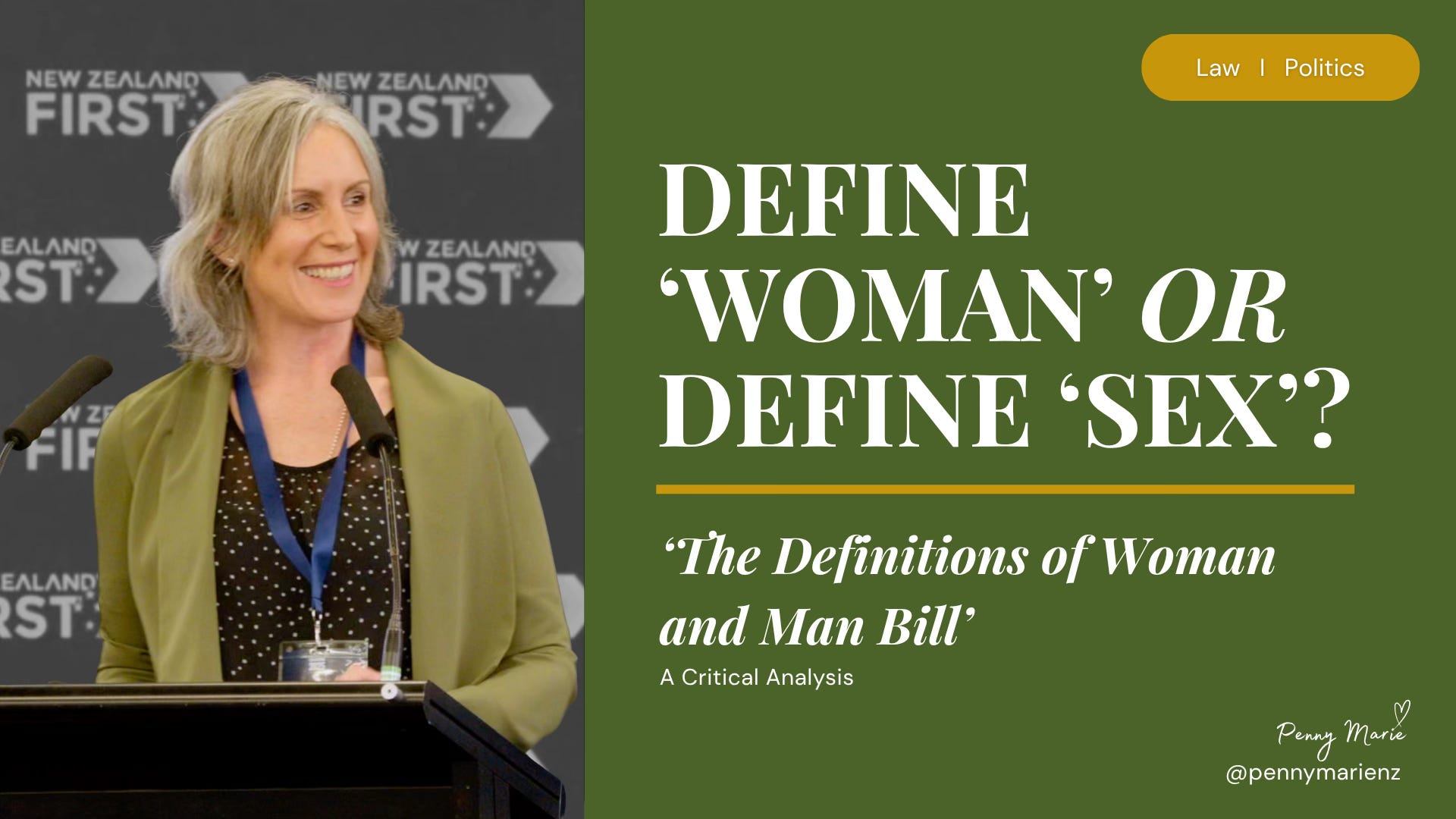
NZ First is the only party in parliament with the courage to even attempt this conversation. Winston Peters and his caucus have consistently stood in rooms where others have gone quiet, and that matters. I have respect for them. I have gratitude for them. I addressed the NZ First Convention on 6 September 2025, and I said to them directly what I am about to say to you. So this is not an attack from the outside. This is what I told them and their members - because I believe they deserve honesty more than they need cheerleading.
The Legislation (Definitions of Woman and Man) Amendment Bill, introduced by NZ First MP Jenny Marcroft and now drawn from the ballot, would insert new sections 13A and 13B into the Legislation Act 2019, defining “woman” as “an adult human biological female” and “man” as “an adult human biological male.” Public polling shows majority support. The intent is genuinely good. But a careful reading of where gender ideology actually entered New Zealand law - and how - tells me this bill addresses the wrong problem.


The real problem is not the word “woman.” It is the word “sex.”
The activist overreach that sex-based rights advocates have documented over the past decade does not flow from any ambiguity in how legislation defines “woman.” It flows from the Human Rights Commission’s interpretation of “sex” - a word that appears in section 21 of the Human Rights Act 1993 as a prohibited ground of discrimination, but which is not defined in that Act. The HRC has, for years, taken the position that gender identity and expression fall within the scope of “sex” as a prohibited ground. That interpretation is embedded in its guidance, its communications, and its complaint-handling.
The bill does not define “sex.” It does not amend the Human Rights Act. It does not constrain the HRC’s interpretation of sex in any enforceable way. A defined “woman” in the Legislation Act does not tell the Commission - or any tribunal - what “sex” means in the Act the Commission actually administers. The lever that matters has not been touched.
There is a second problem, and it cuts in the other direction
Both new sections open with the phrase “regardless of gender identity.” That phrase introduces “gender identity” as a named legal concept into the Legislation Act for the first time.
Currently, it has no legislative footprint there. This bill would give it one. For those of us who argue that gender identity is a contested philosophical construct that should not appear in statute at all - this is not a small concession. Naming a concept in law, even to override it, is still naming it. That is the opposite of the direction we have been calling for.
What I said to NZ First leadership and party members
At the NZ First Convention I said this:
“I’m done working only with the low-hanging fruit. We need to get to the core of the issues assaulting our society.” - Penny Marie
The Marcroft bill is, by that measure, exactly the kind of low-hanging fruit I was describing. It adjusts a definition without touching the legislative infrastructure through which gender ideology was actually introduced into New Zealand law.
Watch the speech I gave at the NZ First Convention in 2025
That infrastructure is specific and traceable.
The Conversion Practices Prohibition Legislation Act 2022 compels affirmation-only responses to gender-confused children and puts counsellors, parents, and religious communities at legal risk if they explore root causes or alternative frameworks.
The Births, Deaths, Marriages and Relationships Registration Act 2021 introduced a self-identification process that allows individuals to change the sex recorded on their birth certificate through a statutory declaration alone - no medical requirement - a mechanism that has been used to advance the narrative that legal sex and biological sex are legally separable concepts.
Neither of these Acts is touched by the NZ First bill.
I asked NZ First leadership directly at the convention
“So what are you personally, what is NZ First, willing to do in the run-up to next year’s election, to fix what certainly is an ideological takeover of legislation, policy and crown agencies? We are seeing social engineering coming through our education. It doesn’t look like it’s being corrected under the current coalition government.” - Penny Marie
They heard the full analysis that day:
The Yogyakarta Principles pipeline
The Human Rights Commission’s activist role
The downstream effects on school policy
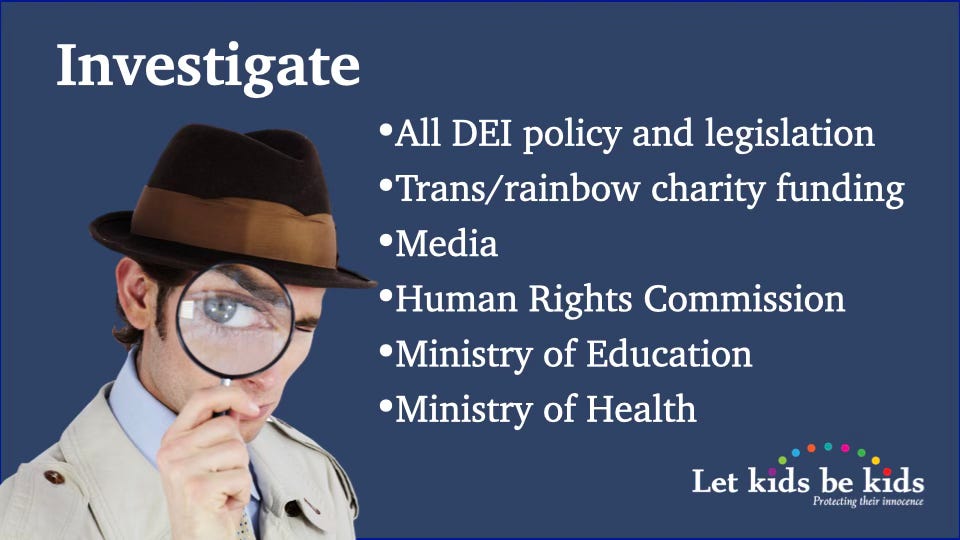
And a specific list of entities I put forward for investigation:
All DEI policy and legislation
Trans and rainbow charity funding
Media
The Human Rights Commission
The Ministry of Education
The Ministry of Health.
A members’ bill defining “woman” in the Legislation Act does not trigger any of those investigations. It does not repeal the Acts that gave gender ideology its statutory footing - the two Acts named in this article.
I used a metaphor in my address that I still think is right.
“We slid off the cliff, and at the bottom is a broken and battered ambulance. So how do we climb back up?” - Penny Marie
The Legislation (Definitions of Woman and Man) Amendment Bill is not the climb. It is a definitional patch applied to the ambulance.
The climb - the actual legislative correction New Zealand - requires:
The repeal of the Conversion Practices Prohibition Legislation Act 2022, which chills counsellor and parental freedom to explore anything other than gender affirmation with gender-confused children.
And the correction of the self-identification provisions in the Births, Deaths, Marriages and Relationships Registration Act 2021, which severed the legal connection between recorded sex and biological sex.
Until those Acts are addressed, a new definition of “woman” in the Legislation Act is a footnote to a much larger failure.
I said this to NZ First. I’m saying it to you now. I do not think less of them for the attempt. But I will not pretend this is the fix when I know - and they surely know - that it isn’t.
Penny Marie
Penny Marie is a New Zealand-based advocate for sex-based rights and spoke at the NZ First Convention on 6 September 2025.
My previous post


 | A guest post by
|
Great points Penny. Pulling the weed out at the root, not just at ground level. It will continue to grow if not properly removed.
In legal terms, isn't 'sex' typically referencing the biological classification of individuals as male or female based on physical characteristics, such as chromosomes, hormones, and genitalia.
By defining woman & man, then by extention isn't 'sex' also being defined?
Shame they have included reference to gender identification in first sentence of each definition ... agree with your 2nd point as it would seem more difficult to then remove and correct the other two Acts you have outlined.